Prototype Cable Could Enable Sub-5 minute Charging Times for EVs
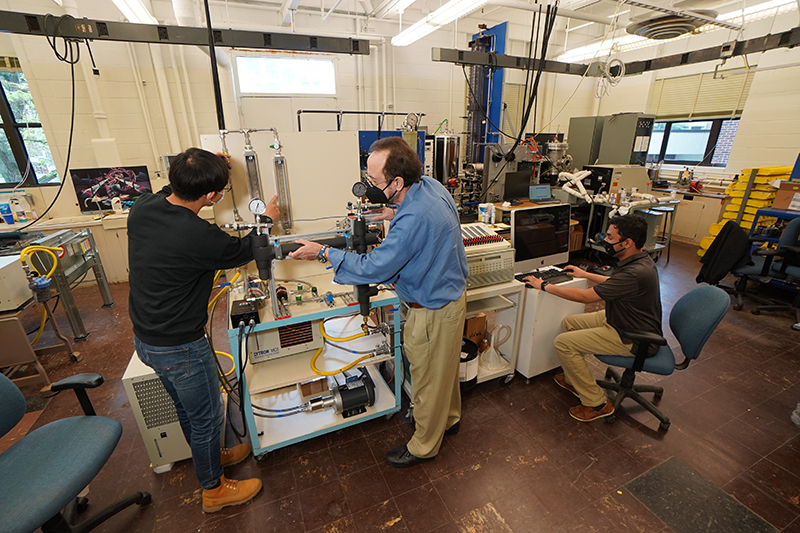
The biggest drawback for electric vehicles right now is “range anxiety” – or the limiting factors of its electric range – and the biggest variable for that is charging speed. Purdue University engineers just developed a prototype charging station cable that could bring EV “refueling” times in line with internal combustion engines.
It goes without saying, but if EV owners can’t pull into a truck stop or refueling station and recharge their cars relatively quickly, they’ll never catch on with the broader public.
The $1.2 trillion infrastructure deal that was just finalized contains $7.5 billion for a nationwide network of EV charging stations, but if the tech isn’t there, it won’t matter if the infrastructure is.
And as it stands, the batteries, themselves, aren’t the biggest impediment to charging speed (not directly, anyway). It’s thermal management, and the danger of overheating.
With modern technology, you can only charge a battery so fast without starting a fire. To push beyond contemporary limits, you’d need to disperse a large amount of heat, which is where Purdue comes in.
Purdue engineers claim their prototype charging cable can deliver a current 4.6 times that of the fastest available EV chargers on the market today by removing up to 24.22 kilowatts of heat.
“My lab specializes in coming up with solutions for situations where the amounts of heat that are produced are way beyond the capabilities of today’s technologies to remove,” said Issam Mudawar, Purdue’s Betty Ruth and Milton B. Hollander Family Professor of Mechanical Engineering.
Modern chargers deliver up to 520 amperes safely, and you’d need to reach the 1,400-ampere threshold to achieve recharging speeds of < 5 minutes (Purdue’s prototype can accommodates a current of over 2,400 amperes).
There’s just one problem – this is all theoretical. No EV battery can handle amperes that high, so Purdue’s cable hasn’t been tested on actual vehicles.
As Purdue points out, to hit their lofty recharge goal, the power output ratings of the power supply and charging cable, and the power input rating of the EV’s battery will each need to be rated to 2,500 amperes.
Purdue intends to work with automakers to test their cable on real-world EVs within 2 years.