Editor Blogs

    Army Pairs Humans with Robots and LIDAR Sensors
    08/25/2020
    Jason Lomberg, North American Editor, PSD
    Tag: @USArmy @armyresearchlab #sensors #lidar #lidarsensor #psd #powerelectronics
    Army Pairs Humans with Robots and LIDAR Sensors
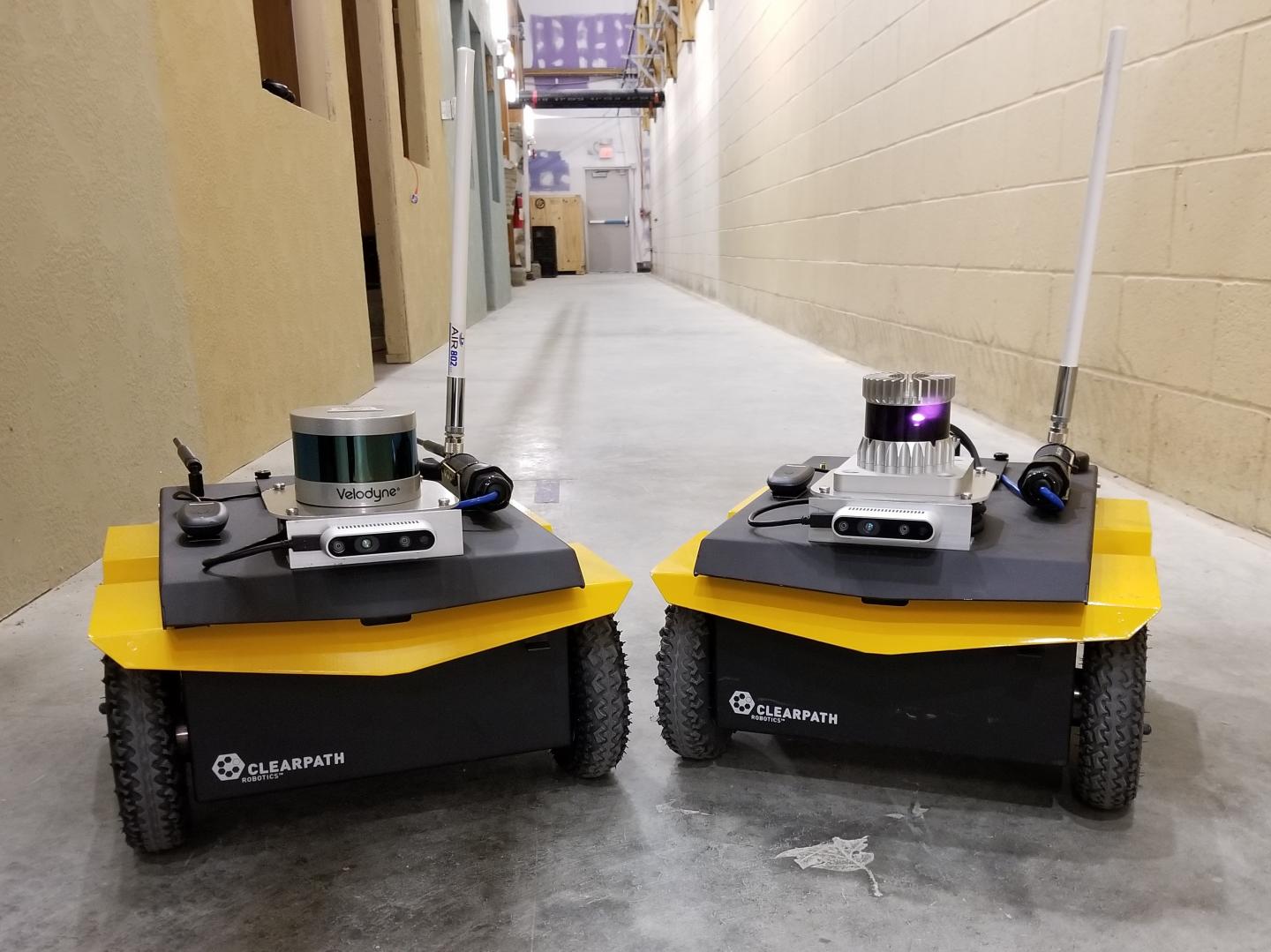
    The two robots used in the experiments are identically equipped, with the exception of Velodyne VLP-16 LiDAR (left) and Ouster OS1 LiDAR (right).


    This “battle buddy” doesn’t get tired, and to paraphrase a line from The Terminator, it doesn't feel pity, or remorse, or fear. And it absolutely will not stop, ever, until … you have a complete picture of your environment.

    Military robots/drones/UAVs aren’t exactly new. In the air, creations like the MQ-1 Predator and MQ-9 Reaper rain destruction on America’s enemies, while ground systems like the Packbot and Gladiator Tactical Unmanned Ground Vehicle do everything from defuse bombs to surveillance, reconnaissance, and even combat.

    And they’ve evolved with the times.

    The U.S. Army Research Laboratory (ARL) has been pairing soldiers with specially-equipped ground robots, with the latter sporting LIDAR sensors in order to provide total situational awareness.

    The Velodyne VLP-16 LiDAR and Ouster OS1 LiDAR detect physical changes in 3D and conveys that information back to their human counterpart in real-time through augmented reality. The key factor in future warfare is information (and who has more of it). That and overwhelming firepower.

    “This could let robots inform their Soldier teammates of changes in the environment that might be overlooked by or not perceptible to the Soldier, giving them increased situational awareness and offset from potential adversaries,” said Dr. Christopher Reardon, a researcher at the U.S. Army Combat Capabilities Development Command’s Army Research Laboratory. “This could detect anything from camouflaged enemy soldiers to IEDs.”

    This will lead to more interaction between human and robot, improving the “autonomous context understanding and reasoning capabilities of the robotic platform … such as by enabling the robot to learn and predict what types of changes constitute a threat.”

    Read more here.

    Recent
    AI Agent Autonomously Hacks a Rival, Spurring the Industry to Action

    AI Agent Autonomously Hacks a Rival, Spurring the Industry to Action

    07/28/2026
    Jason Lomberg, North America Editor, PSD
    New York Places 1-Year Moratorium on New Data Center Construction

    New York Places 1-Year Moratorium on New Data Center Construction

    07/16/2026
    Jason Lomberg, North America Editor, PSD
    How Close are we to Solid-State EVs?

    How Close are we to Solid-State EVs?

    07/14/2026
    Jason Lomberg, North America Editor, PSD
    Report: Data Center Energy Demand is Growing Faster than Supply

    Report: Data Center Energy Demand is Growing Faster than Supply

    07/06/2026
    Jason Lomberg, North America Editor, PSD

    Power Systems Design

    146 Charles Street
    Annapolis, Maryland 21401 USA

    Power Systems Design

    Power Systems Design is a leading global media platform serving the power electronics design engineering community. It delivers in-depth technical content, industry news, and product insights to engineers and decision-makers developing advanced power systems and technologies.

    Published 12× per year across North America and Europe, Power Systems Design is distributed through online and fully digital editions, complemented by eNewsletters, webinars, and multimedia content. The platform covers key areas including power conversion, semiconductors, renewable energy, automotive electrification, AI power systems, and industrial applications—supporting innovation across the global electronics industry.