Cohda Wireless, Cisco, and NXP advance connected vehicle technology
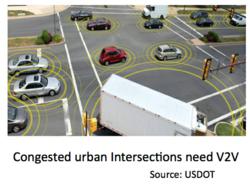
As part of the US Safety Pilot Model Deployment, the University of Michigan Transportation Research Institute (UMTRI) will launch a motorcycle study to determine how cars, trucks, buses and motorcycles interact using V2V (Vehicle-to-Vehicle) communications technology from Cohda Wireless. UMTRI has partnered with two motorcycle manufacturers: Honda and BMW. Cohda Wireless provides the V2V connected vehicle equipment. Two tasks will be conducted in the Safety Pilot Model Deployment Geographic Area as a proof of concept for incorporating motorcycles into the connected vehicle environment. The two tasks are motorcycle communications feasibility testing and motorcycle to vehicle performance testing. The V2V connected vehicle equipment provided by Cohda for these motorcycles is based upon the RoadLINK™ chipset resulting from collaboration between Cohda Wireless and NXP Semiconductors. This automotive-grade, market-ready chipset consists of a software defined radio chip from NXP running connected vehicle firmware from Cohda with unmatched performance. NXP is providing the chipset including firmware in a one-stop shop to customers based on exclusive license with Cohda. "Cohda Wireless is a proven leader in the development of connected vehicle technology. Cohda will add valuable technical expertise to the team to ensure project success," said Assistant Program Manager Debby Bezzina, a Senior Program Manager at UMTRI. Paul Gray, CEO of Cohda Wireless, noted it was extremely important that connected vehicle technology be extended to vulnerable road users such as motorcycle riders and pedestrians. "We are very proud to see our products being used in this important trial to improve the safety of car drivers and motorcycle riders alike." Analysis by the United States Department of Transportation (USDOT) National Highway Traffic Safety Administration (NHTSA) shows connected vehicle technology could potentially address approximately 80 per cent of the crash scenarios involving non-impaired drivers. Furthermore, according to NHTSA data, motorcycle accidents represent five per cent of all highway fatalities, but 80 percent of the accidents result in injury or death as compared to 20 percent for cars. This makes it vital that connected vehicle technology also addresses these vulnerable road users. Motorcycles have an important role in USDOT's overall safety strategy. Industry excitement grows as trials of vehicle-to-vehicle (V2V) and vehicle-to-infrastructure (V2I) connected vehicle technologies expand throughout the world. As reported, this technology promises to significantly improve safety and mobility. Onboard and road side units from Cohda, Cisco and NXP have been tested to global standards in major field trials. One such trial is the Safety Pilot Model Deployment trial in Ann Arbor, Michigan managed by UMTRI for the USDOT. With almost 3000 vehicles, this trial is the largest connected vehicle trial in the world, and Cohda supplies the equipment for 1500 of these vehicles. Cohda Wireless connected vehicle products are qualified by the USDOT. Governments around the world have chosen Cohda Wireless because of its robust connected vehicle solution. For example, the USDOT Intelligent Transportation Systems Joint Program Office (ITS JPO) selected Cohda as one of the firms to supply equipment for the Connected Vehicle Safety Pilot Model Deployment and other test bed installations. Paul Gray, Cohda's CEO, explains how Cohda's patented connected vehicle technology addresses difficult intersection accidents. "With V2V communications, the vehicles must be able to communicate with each other, even in an urban setting where buildings prevent the drivers at an intersection from seeing each other. Cohda's performance in these safety-critical scenarios is unmatched. We are excited that Cohda, as part of the Ann Arbor Safety Pilot, provides radios to test solutions to the most challenging safety problems." Cohda and Cisco have jointly developed roadside equipment that enables robust V2I communications for such safety applications as Curve Speed Warnings and Traffic Signal Violation Warnings. Both of these applications hold particular importance for motorcycle riders. This roadside equipment has been tested extensively by the USDOT and selected to be on the Qualified Products List (QPL). Cohda has also developed a vehicle awareness device that enables robust V2V communications for such safety applications as Intersection Collision Warnings, Forward Collision Warnings, and Emergency Electronic Brake Lights. Of the seven equipment vendors that were originally selected by USDOT to develop such equipment, Cohda is one of only three vendors to make the final Qualified Products List. "The USDOT requirements are stringent, and their qualification testing is exhaustive. It was a lot of work, but we are pleased that our products have been recognized on the QPL," said Paul Gray. Cohda Wireless UMTRI NXP Semiconductors